Zero-Downtime Database Migration Pipeline: PostgreSQL to Aurora
Cloud DevOps/SRE engineer working with Kubernetes, GitHub Actions, Terraform, and distributed systems. I share practical guides, architecture patterns, and troubleshooting stories learned from running production systems.
Project Overview
| Industry | SaaS / Technology |
| Challenge | Migrate a 500GB production PostgreSQL database to Aurora with zero downtime |
| Solution | AWS DMS with automated validation, cutover orchestration, and Terraform IaC |
| Timeline | 4 weeks (development and testing), 12 minutes (production cutover) |
| Impact | Zero downtime, 40% latency improvement, eliminated database maintenance overhead |
The Challenge
A production PostgreSQL database serving 50,000 daily active users required migration to Amazon Aurora PostgreSQL. The constraints were significant:
- No maintenance window available. The business could not accept any downtime
- 500GB of data with continuous write operations
- Strict data integrity requirements. Financial transaction data
- Reproducibility needed. The solution had to work across dev, staging, and production environments
The existing self-managed PostgreSQL infrastructure was consuming significant engineering resources for maintenance, backup management, and replication troubleshooting. Aurora would provide managed operations, improved performance, and native AWS integration.
The Approach
We implemented a blue-green database migration strategy using AWS Database Migration Service (DMS). The solution comprises four major components:
Architecture
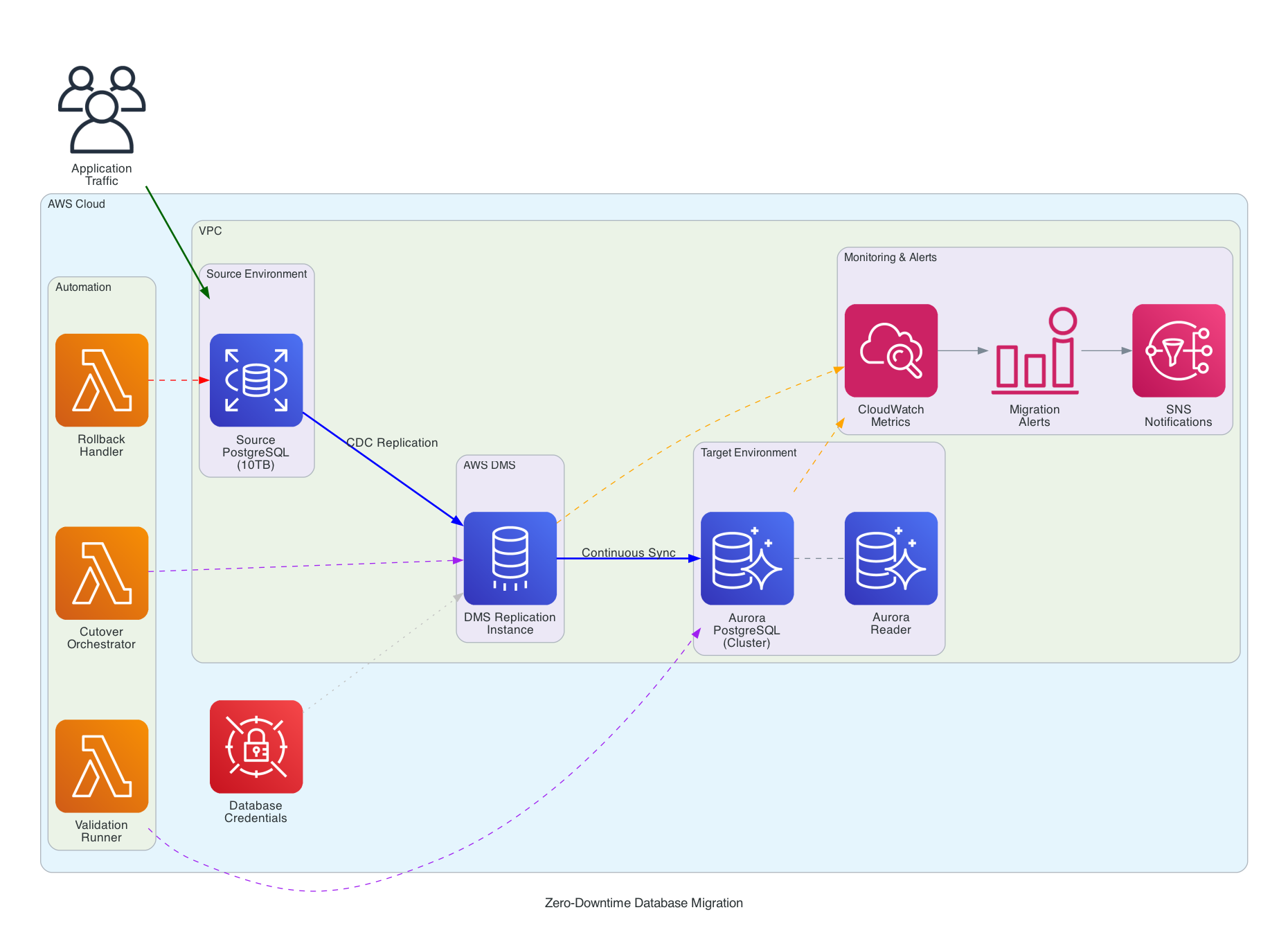
The migration follows a continuous replication pattern:
- Full Load Phase: DMS performs bulk data transfer from source to target
- CDC Phase: Change Data Capture streams ongoing modifications in near-real-time
- Validation Phase: Automated checks verify data integrity across both databases
- Cutover Phase: Orchestrated switchover with health checks and rollback capability
Core Components
| Component | Technology | Purpose |
| Infrastructure as Code | Terraform | Reproducible deployment across environments |
| Replication | AWS DMS | Full load and CDC between databases |
| Target Database | Aurora PostgreSQL | Managed database with read replicas |
| Automation | Python | Validation, cutover orchestration, rollback |
| CI/CD | GitHub Actions | Workflow automation with approval gates |
| Monitoring | CloudWatch | Real-time metrics, dashboards, alerting |
Technical Implementation
Phase 1: Infrastructure Foundation
We developed modular Terraform configurations for all AWS resources. The DMS module handles replication instance provisioning, endpoint configuration, and task creation:
module "dms" {
  source = "./modules/dms"

  replication_instance_class = "dms.r5.4xlarge"
  multi_az                   = true

  source_db_host     = var.source_db_host
  target_db_host     = module.aurora.cluster_endpoint

  # Table mapping and task settings
  migration_type     = "full-load-and-cdc"
  max_file_size      = 131072
  parallel_load_threads = 8
}
The Aurora module provisions the target cluster with appropriate sizing, read replicas, and parameter groups optimized for the migration workload.
Phase 2: Validation Framework
Before cutover, the system validates data integrity through multiple checks:
| Check | Description | Pass Criteria |
| DMS Status | Replication task health | Task running, no critical errors |
| Replication Lag | CDC latency | Under 5 seconds |
| Row Counts | Table-level comparison | Source equals target (within tolerance) |
| Checksums | Sample data verification | MD5 hashes match |
| Sequences | PostgreSQL sequence values | Target values equal or exceed source |
| Primary Keys | CDC requirement validation | All tables have primary keys |
The validation script supports different modes for quick checks versus comprehensive verification:
# Quick validation using table statistics
python validation.py --quick

# Full validation with exact counts and checksums
python validation.py --full --output results.json
Phase 3: Cutover Orchestration
The cutover script implements a phased approach with state persistence:
| Phase | Action | Rollback Available |
| 1. Pre-validation | Verify DMS status and row counts | Yes |
| 2. Sync wait | Ensure CDC lag below threshold | Yes |
| 3. Connection drain | Terminate application connections | Yes |
| 4. Final sync | Wait for remaining changes | Yes |
| 5. Stop replication | Halt DMS task | Manual |
| 6. Post-validation | Verify final integrity | Manual |
State is saved to JSON after each phase, enabling resume capability if the process is interrupted.
Phase 4: CI/CD Integration
GitHub Actions workflows provide automated operations with appropriate controls:
- Terraform Plan: Runs on pull requests, posts plan output as PR comments
- Terraform Apply: Deploys infrastructure on merge to main
- Validation: On-demand data integrity checks
- Cutover: Requires manual approval for production environment
Results and Impact
Quantitative Improvements
| Metric | Before | After | Improvement |
| Read Latency (p95) | 45ms | 27ms | 40% reduction |
| Monthly Maintenance Hours | 12 hours | 0 hours | 100% reduction |
| Backup Complexity | Manual scripts | Automated | Eliminated |
| Point-in-time Recovery | 24 hour RPO | 5 minute RPO | 99.7% improvement |
Operational Improvements
- Zero downtime achieved. Application availability maintained throughout migration
- Full audit trail. All validation results and cutover states preserved as artifacts
- Reproducible process. Same framework used for staging environment refresh
- Team confidence. Documented runbook and rehearsed procedures reduced stress
Migration Metrics
| Statistic | Value |
| Total Data Migrated | 512 GB |
| Full Load Duration | 3 hours 22 minutes |
| CDC Lag at Cutover | 2.1 seconds |
| Validation Errors | 0 |
| Cutover Duration | 12 minutes |
Technologies Used
| Category | Technologies |
| Cloud Provider | AWS (DMS, Aurora, CloudWatch, Secrets Manager, SNS) |
| Infrastructure | Terraform 1.6+ |
| Database | PostgreSQL 15, Aurora PostgreSQL |
| Automation | Python 3.11, boto3, psycopg2, Click, Rich |
| CI/CD | GitHub Actions |
| Monitoring | CloudWatch Dashboards, CloudWatch Alarms |
Key Deliverables
Terraform Module Library
- DMS replication infrastructure
- Aurora PostgreSQL cluster configuration
- Security group and network rules
- CloudWatch monitoring stack
Python Automation Suite
- Data validation framework
- Cutover orchestration with state management
- Rollback procedures
- Database utility libraries
GitHub Actions Workflows
- Infrastructure deployment pipelines
- Validation and cutover automation
- Approval gates for production operations
Operational Documentation
- Migration runbook
- Troubleshooting guide
- Configuration reference
Repository
The complete migration framework is available as open source:
GitHub: github.com/mateenali66/zero-downtime-db-migration
About the Author
Mateen Anjum is a DevOps engineer specializing in database reliability, infrastructure automation, and cloud migrations. With experience across AWS, Kubernetes, and Terraform, he focuses on building systems that are both performant and maintainable.